Jake Paul's MVP Dips Its Toes
Into Women’s MMA: Ronda Rousey's Return Announced
Picture
Jake Paul and business partner Nakisa Bidarian sitting across
from Netflix executives last fall, pitching a huge MMA event
headlined by two fighters whose combined ring absence stretches
back further than most fans' attention spans. One fighter
revealed in her own memoir that undisclosed concussions forced
her out of the sport. The other got fired from Star Wars and had
quite a bit of fallout to handle before anyone asked her to lace
up 4oz gloves again. Imagine making that pitch with a straight
face. Now imagine it working.
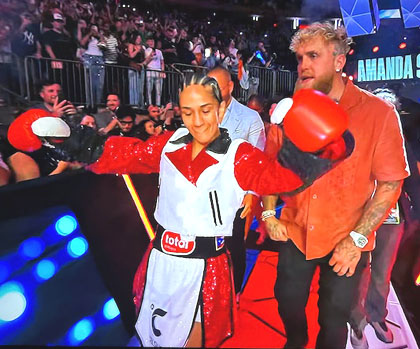
Jake Paul has become a revolutionary
in the world of women's boxing, catapulting stars such as Amanda
Serrano to new heights. Now, he's dipping his toes into the
women's MMA world, and he has started his crusade at the very
summit: snapping up the sport's greatest trailblazer—Ronda
Rousey.
Ronda Rousey
Returns Under MVP Banner
"Rowdy"
became arguably the biggest combat sports star in the
world—certainly in the UFC—a decade ago. The former Olympic
bronze medalist was sweeping all before her in an epic run as
the inaugural UFC bantamweight champion. Fast forward to 2026,
and after over ten years out of the cage,
Rousey will step back in,
facing off against fellow veteran superstar Gina Carano at the
Intuit Dome in Los Angeles on May 16th.
Online
betting sites have already gotten in on the act, pricing up the
blockbuster affair three months out from it actually taking
place. Websites that allow one to bet
on sports with crypto
make Rousey a mighty -700 favorite, with Carano way out at +525
to spring the upset.
Note to client of Thunderpick: Womenboxing.com is located in
the state of Washington our state laws do not allow gambling
links. Contact us asap to put a legal link on this article.
email:
wban100@aol.com
Rousey (12-2) hasn't competed since
Amanda Nunes turned her lights out 48 seconds into UFC 207 in
December 2016. Carano (7-1) hasn't stepped inside a cage since
Cris Cyborg punished her over five excruciating rounds in August
2009. Between them, that's 26 years of ring rust and about a
hundred reasons this could go sideways.
And yet. Here we are.
MVP's Tried
and Tested Method
Is this a legitimate sporting event
or the most expensive nostalgia trip combat sports has ever
staged? Considering Netflix paid $20m to a 58-year-old Mike
Tyson to get in the ring with Paul, perhaps not. But what makes
it impossible to dismiss is that MVP's promotional machine has
already proved cynics wrong once, systematically, with receipts.
See the mind-boggling amounts of money the Problem Child has
been paid to fight washed-up tomato cans. See his willingness to
step up to the plate and put on a show against Anthony Joshua,
knowing full well he could end up in the ER (spoiler alert: he
did, broken jaw and all).
Rousey called this the "biggest
superfight in women's combat sports history," and credited
Carano as the pioneer who opened every door she walked through.
Whether you buy the sincerity or not, the marketing is
immaculate. It marks Netflix's first live MMA event, extending a
streaming sports relationship that's already rewritten women's
boxing economics. The question isn't whether Paul can hype it.
It's whether the fight itself can survive the hype.
But this isn't Paul's first rodeo,
disrupting a combat sports market everyone assumed was already
figured out. His blueprint with women's boxing was exactly this:
identify massively undervalued talent, attach Netflix's
platform, and force the industry to confront its own negligence.
What Jake
Paul Did for Women's Boxing
Amanda Serrano
earned $1,200 for her boxing debut. Before MVP, she was working
full-time as a boxing trainer between fights, a seven-division
world champion making $1,000–$2,000 per bout—less than a
mid-tier regional kickboxer. She'd considered quitting boxing
entirely to try MMA in 2016, frustrated by an industry that
couldn't figure out how to monetize arguably its most gifted
female fighter.
Then
Jake Paul signed her
to a blockbuster deal.
Let's be clear about what Paul
is—he's a businessman who identified extremely undervalued
assets and capitalized on them. He's someone who looked at the
gap between Serrano's talent and her paycheck and saw arbitrage.
Serrano now earns over $1 million per fight, sometimes
significantly more. Her purse trajectory—$1,200 to eight figures
across multiple fights—is one of the most dramatic compensation
corrections in sports history.
The irony co-hort Bidarian knows
well is that there has been a similar issue for Rousey; she has
huge mainstream crossover appeal, but hadn’t seen the kind of
compensation that she might be capable of earning. Sure, she was
still the highest-earning athlete in the company, but she should
have been garnering far more, especially when you consider her
popularity.
MVP drew directly from those
lessons. Bidarian's challenge was building something
sustainable, rather than star-dependent, which explains the
20-plus fighter roster that includes Alycia Baumgardner,
Chantelle Cameron, Savannah Marshall, and Dina Thorslund
alongside Serrano.
The honest caveat, though? There is
still scope to even things up and improve the situation for many
fighters. The model is genuinely better than what existed
before, but time is likely to see further shifts in this
direction.