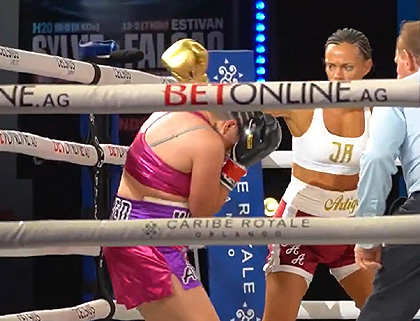
Artiga Defended her WBA Title Against Stephanie Silva
winning by a Decisive Victory
(DEC 16) The December 13, 2025, clash between
Jasmine “The Animal” Artiga and Stephanie Silva shaped up to be one of the
most consequential women’s super-flyweight fights of the year. Set for Orlando,
the bout carries implications far beyond a single title defense, touching
rankings, future unification possibilities, and global promotional interest.
With both fighters entering the ring at pivotal moments in their careers, this matchup represented a genuine turning point for the division.
On this night Jasmine Artiga, 113 1/4, of Tampa, Florida, won the fight with
a ten-round unanimous
decision, over Stephanie Silva, 119 1/2. The judges scores were 97-93,
100-90, and 99-91. In pre-fight predictions:
December 13, 2025, in Orlando: Why This Night Can
Flip the Division
On December 13, 2025, Orlando becomes the focal point of the women’s
super-flyweight landscape. Jasmine Artiga steps into the ring as the established
champion, carrying momentum, home-region of familiarity, and the expectations
that come with dominance. Across from her stands Stephanie Silva, a challenger
whose rise through the WBC Silver ranks, has earned her a legitimate claim to
world-level contention.
This is not a routine defense placed on a
calendar for activity’s sake. The timing aligns with a division in flux, where one
authoritative win can leapfrog a fighter into discussions involving unification
bouts, mandatory obligations, or cross-promotional events in both the U.S. and
Europe.
Artiga enters the contest with an undefeated record of 14-0, while Silva arrives
at 10-1, numbers that immediately signal competitive credibility rather than a
showcase mismatch.
Those records, combined with the title implications,
are precisely why promoters and sanctioning bodies are watching closely.
Orlando’s placement on the boxing map for this event is no accident; it’s a
calculated stage for a fight that can reorder the hierarchy at super-flyweight.
Jasmine “The Animal” Artiga’s Trajectory: Momentum Built
the Hard Way
Artiga’s current position at the top of the division is the result of sustained
activity and increasingly decisive performances. Her recent run has demonstrated
a fighter growing more comfortable dictating pace and terms, especially in
championship settings. The most telling example came in her last outing at the
Caribe Royale Resort in Orlando, where she retained the WBA junior bantamweight
title with a dominant TKO victory over Linn Sandström. That stoppage was not
merely a successful defense; it was a performance that reshaped how future
challengers approach her.
Stopping a credible opponent like Sandström sends a message that goes beyond
scorecards. It forces contenders to reconsider survival strategies, conditioning
thresholds, and late-round adjustments. For Artiga, that victory reinforced her
reputation as a champion who doesn’t simply outpoint opponents but breaks them
down systematically. That context makes the Silva fight less about maintaining
status and more about proving that her championship reign can extend into a
defining era.
Stephanie Silva’s Rise: The WBC Silver Belt That
Changed Her Market
Stephanie Silva’s ascent has been built on persistence and tangible achievement
rather than hype. Her capture of the WBC Silver super-flyweight title in Rome,
Italy, against Mary Romero marked a turning point in her career. The fight
itself was described as fiercely contested, with momentum swinging between both
fighters, highlighting Silva’s ability to adapt under pressure and remain
competitive in high-stakes environments.
Holding out the WBC Silver belt does not guarantee a world title, but it carries
significant weight in matchmaking conversations. It signals readiness, ambition,
and legitimacy, particularly for a European fighter looking to break into the
U.S.-centric world title scene. Silva’s willingness to travel for the Artiga
fight further reinforces her intent. Orlando represents not just a title
opportunity but a chance to translate European success onto a global stage.
Orlando Factors: Home Comfort, Home Pressure, and Crowd Energy
Fighting in Orlando offers Artiga comfort and complication. Familiar
surroundings, supportive crowds, and promotional alignment often create an
environment that energizes a champion. At the same time, that same energy can
amplify expectations, pushing a fighter to chase moments rather than manage
rounds. Artiga’s ability to remain disciplined amid crowd reactions will be a
critical factor in how effectively she controls the bout.
For Silva, the Orlando setting is a test of composure. Road fights often demand
clarity and consistency, as even small lapses can sway close rounds away from a
challenger. Silva’s challenge will be to neutralize the atmosphere by
controlling tempo and refusing to let momentum snowball. The venue, crowd, and
regional support all become variables that both fighters must navigate
intelligently.
Women’s Super-Flyweight: A Division Where One Win
Can Reorder the Queue
The women’s super-flyweight division is particularly sensitive to momentum
shifts. Sitting between 112 and 115 pounds, it features a relatively compact
talent pool spread across multiple sanctioning bodies, including the WBA, WBC,
IBF, and WBO. Rankings in this weight class are fluid, and a single standout
performance can dramatically alter mandatory positions and voluntary defense
options.
Because of this volatility, perception often moves faster than paperwork. A
dominant win in Orlando could propel either Artiga or Silva into conversations
involving unification bouts or high-profile defenses. Conversely, a lackluster
showing could stall momentum despite a victory. The Artiga–Silva fight lands at
a moment when the division is particularly receptive to change.
Fight-Week Attention: Why This Matchup Is Pulling
Extra Eyes
The stakes surrounding this bout have generated attention well beyond
traditional boxing circles. Positioned as a high-profile clash on the December
13, 2025, Orlando card, Artiga vs. Silva has drawn interest from sportsbooks
offering competitive incentives to U.S. audiences,
including a bet365 bonus
promoted during fight week. This increased visibility reflects how the bout is
being framed: not as a niche title defense, but as a meaningful career
crossroads.
What drives that attention is not odds-making alone but consequence. Fans sense
when a fight carries long-term implications, and that awareness fuels
engagement. The result is broader media coverage, heightened promotional
interest, and a louder conversation about the future of women’s boxing at
super-flyweight.
Artiga’s Style Problem: Pressure That Forces
Decisions, Not Just Exchanges
Artiga’s fighting style revolves around sustained pressure, intelligent volume,
and a willingness to operate in close quarters. Her recent performances have
highlighted an ability to string combinations together while maintaining forward
momentum, forcing opponents to react rather than initiate. Against Silva, this
approach can either dominate the contest or expose countering opportunities if
applied recklessly.
The key for Artiga lies in controlled aggression. Using feints, varying levels,
and disciplined exits after combinations allows her pressure to accumulate
without becoming predictable. When executed correctly, this style turns rounds
into endurance tests that gradually tilt scorecards and open the door to late
stoppages, as seen against Sandström.
Silva’s Counter-Argument: Adaptability, Composure,
and European Toughness
Silva’s strength lies in her adaptability and composure, qualities forged
through competitive fights that required constant adjustment. Her WBC Silver
title win showcased an ability to weather momentum swings and respond
strategically, rather than relying on a single rhythm. Against Artiga, Silva’s
challenge will be to gather information early, disrupt forward pressure, and
prevent prolonged exchanges from becoming one-sided.
By varying tempo, using angles, and selectively engaging, Silva can force Artiga
to reset repeatedly. Banking competitive early rounds would shift pressure onto
the champion and
test Artiga’s patience. Silva’s toughness and willingness to
fight through adversity make her a dangerous challenger if the bout extends into
later rounds.
Rankings, Sanctioning Bodies, and Opportunity: The Invisible Opponent
Beyond the physical contest, both fighters are competing against an invisible
opponent: future opportunity. Rankings, sanctioning-body preferences, and
promotional narratives all hinge on how this fight unfolds. For Artiga, a clear
and authoritative win strengthens her leverage when discussing future opponents,
venues, and potential unifications. For Silva, even a narrow loss paired with a
strong performance could elevate her standing within the division.
Sanctioning bodies often respond not just to results but to narratives. A fight
that captures attention and demonstrates competitiveness can influence mandatory
decisions and title pathways. That reality adds another layer of importance to
every round in Orlando.
The Turning-Point Scenarios: What Each Outcome Sets in Motion Next
The aftermath of Artiga vs. Silva will echo throughout the women’s
super-flyweight division. An Artiga victory achieved with dominance could open
doors to unification talks and larger promotional stages in the United States or
Europe. It would reinforce her status as a champion worth building events
around.
A Silva victory, on the other hand, would instantly redraw the divisional
map, shifting attention toward European markets and validating the WBC Silver
pathway as a springboard to world titles.
Regardless of outcome, December 13, 2025, stands as a dividing line. The fight
has the capacity to reorder rankings, reshape promotional strategies, and
accelerate long-discussed matchups into tangible negotiations. For women’s
boxing at super-flyweight, this is not just another title fight—it is a moment
that can define the division’s immediate future.