Who Won Women’s Boxing Olympics Throughout the
Years?
Women’s boxing brought a new level of excitement to the Olympic stage when it
debuted at the London 2012 Games. Its inclusion helped promote gender equality
in sports by providing a new arena for female athletes to showcase their
athletic talent. In just four Olympic editions, the sport has already changed
and developed, which is incredible to see in such a short time. Newer weight
classes have been established with exciting rivalries and remarkable
trailblazers.
The Start of Women’s Boxing in the Olympics
Let’s start by answering the question of when did women’s boxing start. Well,
the sport has had a presence in the Olympics for a long time, as demonstration
bouts were held as early as 1904. However, it was pretty much unheard of until
after the second half of the 20th century. Key milestones include:
* The
first Women’s World Amateur Boxing Championships in 2001
* The
vote by the IOC in 2009 to gain women’s boxing status as a
full-medal sport made way for it to officially debut at London
2012.
There was even a funny controversy surrounding fighting attire. Initially,
female boxers were required to wear skirts, but this was eventually dropped
following a petition led by Elizabeth Plank. A big victory for both comfort and
performance!
Notable Moments in Women’s Boxing Olympic History
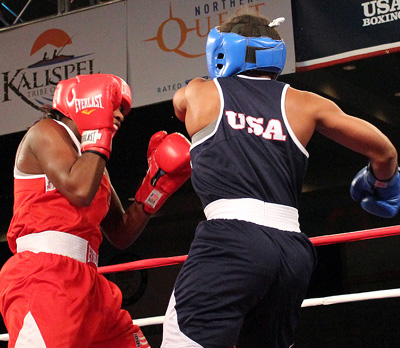
Women's Olympic boxing has produced some memorable and significant moments since
its inception at London 2012. If you are wondering who won womens boxing first,
it’s Nicola Adams, who became a national hero in the UK. Claressa Shields
demonstrated her youth and dominance by winning gold medals in 2012 and 2016.
There is also Sena Irie who inspired a whole new wave of female boxers
throughout Asia by winning Japan's first women’s boxing gold at Tokyo 2020.
These kinds of developments illustrate how both digital platforms and Olympic
stages are effectively creating new representations of inclusion and excellence
within contemporary settings.
The Women’s Boxing Gold Medalists: A Breakdown of Champions
In the list below, you can find out who won gold in
women’s boxing year-by-year.
In the list below, you can find out who won gold in
women’s boxing year-by-year.
**2012 (3 divisions)
** Flyweight (51 kg) Nicola Adams
** Lightweight (60 kg) Katie Taylor
** Middleweight (75 kg) Claressa Shields
**2016 (same three classes)
** Middleweight (75 kg) Claressa Shields
**2020 Tokyo (five classes)
**Featherweight (57 kg) Sena Irie
**2024 Paris (6 classes)
**Flyweight (50 kg) Wu Yu
**Bantamweight (54 kg) Chang Yuan
**Featherweight (57 kg) Lin Yu-ting
**Lightweight ( 60 kg) Kellie Harrington
**Welterweight (66 kg) Imane Khelif
**Middleweight (75) Li Qian
Insights from Boxing Experts
Experts and analysts have talked passionately about the evolution of Olympic
women’s boxing, noting its technical sophistication and global reach. BBC Radio
5 Live analyst Steve Bunce characterized the Paris 2024 tournament as "an
absolute disaster" due to the high profile gender-eligibility issues. But, he
had moments of sympathy as well, as he quoted:
"I think it has hurt Olympic boxing at a crucial time… you'd have to have a
little bit of a feeling for Khelif. She's stuck in the middle of something here
that's absolutely devastating."
From another perspective, gym coach Mustapha Bensaou, who has coached the
Algerian champion Imane Khelif, saw it this way: "The slander has given her a
boost.. It's a bit of a blessing in disguise."
As women's boxing gained global popularity, it naturally sparked growing
interest from sports fans and bettors alike. Today, many enthusiasts explore
betting options around major events, especially during the Olympics. For
educational purposes only, for those in New Zealand, navigating this
space, platforms like
casinoreviews.co.nz
offer valuable resources-not just about online casinos, but also about where and
how to place informed bets. With expert comparisons, transparent reviews, and
bonus breakdowns, they help users make smart, responsible choices-much like the
visibility and opportunity women's boxing has brought to a once male-dominated
sport.
[note: There are only eight USA states where
online casinos are legal in 2026. The states with legal online casinos currently
include Delaware, Maine, Michigan, New Jersey, Pennsylvania, Rhode Island, and
West Virginia. Nevada is another of the states where online gambling is legal,
but only for iPoker, not casinos.]
These kinds of developments illustrate how both digital platforms and Olympic
stages are effectively creating new representations of inclusion and excellence
within contemporary settings.
Weight Classes in Women’s Boxing
If you are asking yourself what are the weight classes in women’s boxing, they
are designed to ensure fair play by grouping players with similar body mass. It
began with just 3 divisions in 2012. Since then, it has grown to six. During the
years 2012-2016, the sport added Fly (51 kg), Lightweight (60 kg), and
Middleweight (75 kg). In 2020, it expanded to five, and in 2024, there were six,
with Bantam and Welter joining. A seventh class is planned for the Los Angeles
Olympics in 2028.
How Many Rounds in Women’s Olympic Boxing?
How many rounds in women’s Olympic boxing, you may ask. Well, you might be
surprised to know that there are 4 rounds of two minutes, which is shorter than
the men's three rounds of three minutes. This rule, introduced in 2000, balances
the safety of the athlete with tactical depth. It's a simple format that has
allowed for some engaging and tactical fights.
Modern-Day Boxing and Its Influence on Women’s
Sports
For many, who won women’s boxing Olympics doesn’t even matter anymore. People
are simply happy that a female has participated and won in boxing. The
visibility of Olympic champions such as Katie Taylor, Nicola Adams, and Claressa
Shields has broken down barriers and encouraged girls from the far corners of
the world.
As women’s boxing continues to advance on the
Olympic stage, its value goes far beyond medal counts. The investment at the
national level, the level of global competition, and viewer interest are
surging, making it one of more popular amateur sports to watch. Similarly, we
are seeing the same changes evolving in the digital entertainment world. For
example, educational and entertainment purposes only, you can
take jackpot city bonus codes by casinoanalyzer
to unlock deposit matches, free spins, or other perks—something many sports fans
explore alongside watching the fights. This makes the whole gameplay much more
rewarding and engaging. [This is for New Zealand and not in the USA].
A Historical Perspective: The Growth of Women’s
Boxing
The introduction of women's boxing as an Olympic sport in London 2012
represented a cultural change. Before that, female boxers had to fight for
recognition in a sport in which men traditionally dominated.
As a result, the Olympic platform encouraged more national programs to invest in
women's boxing, which included things like coaching and training. As there are 7
weight classes expected for LA 2028, it's clear to say that the Olympic movement
is committed to further developing women's boxing.