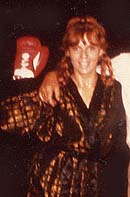
One on One Interview with Karen Martin
Conducted by Lucy Jolin
November 27, 2002Lucy Jolin is a journalist, aspiring kick-boxer and fan of women's
boxing. She's currently investigating just why the UK's so short of women
boxers. 32-year old Karen Martin, an American boxer currently living
and training in the UK, gives her view.
Jolin: Are you married
and do you have any children? If so, how does your husband/children feel
about you being a boxer?
Martin: I am married, and my husband, Andrew, is my manager. He
is my main supporter and encourager. He loves me being involved at this
level of boxing.
Jolin: Do you do any other work?
Martin: In California, I was a full-time primary school teacher (grade
4/year 5). Now, I am a supply teacher in the Warrington area.
Jolin: When did you start boxing and why?
Martin: I started amateur boxing in 1999, and turned professional in
2000 after winning the California Golden Gloves Championship. I initially
started in cardio-kickboxing, but then later was told by the trainer that
I should take it more seriously. He then introduced my to the legendary Lily
Urquidez Rodriquez (boxing and kickboxing great).
Jolin: How long have you been boxing?
Martin: I’ve been boxing professionally for two years.
Jolin: Why did you decide to come to the UK?
Martin: My husband’s company offered him a position here to help with
a large contract to upgrade the water systems in the Northwest. It was a
great opportunity for him to further his career, and a fantastic way for
us to get to see Europe.
Jolin: Was it hard starting out – learning to cope with
the pain of being hit?
Martin: My first encounter with a punch was when I first started, and I
got a ‘fat lip’ from a guy that wanted to prove he was better than me.
My jaw was sore after that, and I swore that I didn’t want to be hit
like that again. Because of the immense amount of adrenalin
during a match, though, there isn’t much time to feel pain. If you have
good defence, the punches are either glancing blows, or they are missed
altogether. Most pain isn’t felt until the next day (especially if hits
were taken to the back of the head). At least that’s where I have felt
pain after a fight.
Jolin: Did you encounter any prejudice in the States as a
woman boxer? If so, can you give me any specific examples?
Martin: The most prejudice women boxers receive in America, is that the
big promoters rarely are interested in putting women on their big cards to
be televised. But we are getting on under-cards much more often, and that’s
encouraging. The female fighters that can put on their own cards (a la Laila
Ali et al) will be seen by the masses. There are more women’s
cards being broadcast, but the there is a list of great, skilled women
boxers that include the likes of Kelsey Jeffries,
Ann Wolfe, Sumya
Anani, Corrine Van RykdeGroot, Ada Velez, Melissa
Del Valle (Salamone), and, oh, Karen Martin "The Natural Born
Thriller", that could also grace television screens. It is my hope
that the public will see women like these broadcasting their skill for
your enjoyment in the near future.
Jolin: If so, also, how did it make you feel – did you
ever feel like giving up?
Martin: The politics of boxing on a whole is frustrating. It has driven
many a woman away from the sport. I have to be honest and say it has
danced around my mind one or two times. But the main focus is a fighter’s
mindset. If your head and heart aren’t into it anymore, you should not
be boxing. Injuries and setbacks in a fighter’s career are usually
enough to make a boxer want to quit. Eighty percent of the fight is in
your mind, 20 percent is your body. If everything around you is falling
apart, and you can’t cope with it, get out. You can really get hurt in
this sport.
Jolin: What was your first match like? Were you nervous?
Martin: My first amateur match was against a woman named Kathy Goode, a
lean, mean, muscular built female. She was taller and bigger than me, but
I wasn’t nervous, I just wanted to ‘play’ boxing. Other women
fighters continued to tell me prior to the fight that they were glad they
weren’t fighting Ms. Goode. I stepped into the ring and my trainer said,
"Don’t forget your head movement." I started bobbing and
weaving and doing all these fancy moves until Ms. Goode slammed two hard
jabs at me. That’s when I knew that she wasn’t playing. She started to
push and grab my head and punch, and then I was angry. The referee
separated us, and she punched me on the split. At that point, I was
furious, especially since the ref told me not to grab. I told him I wasn’t
and that he should tell her to stop, he told me not to talk, and then I
started yelling at her saying, "Come on, it’s on now!" When we
finally got back to the action, it was a flurry of fury. No skill, just
anger. The fight was stopped at forty-seven seconds of the first round,
when the referee pulled me off of her. I spoke to that same ref later, and
he said he had never seen a woman hit that hard before, that’s why he
had to stop the fight.
My first professional fight started with quite a bit of calamity. Not
to mention I was rear-ended by another boxer, 2 days before the match. The
fight was cancelled because the main event could not make it, and we found
that out at the weigh in. Later that day, we (my brother and his family
had flown to California for the fight) drove to Las Vegas and then got a
call to say that the fight was back on. This fight was to be televised, so
the weigh-ins and interviews had to be done the day of the fight, but I
was still excited that it was going to happen. As with most women boxers,
I knew nothing of my opponent except that she had one win and no losses.
The contract was made for 126 pounds (9stone), but when we were about to
weigh in, the contract was changed to 130 lbs. (I really weighed 121 lbs
at the time because I had lost about 4-5 pounds during that hot summer on
nerves). All of my clothes were on. Ms. Rojas was slower, with very little
movement in the ring. I had a lot of movement, and utilized my jab and
speed. The hype for this fight lasted much longer than the actual match;
it was stopped at 1:47 of the first round. I was truly on a high after
that.
Jolin: How is the women’s boxing world different from
that of the USA? Would you say that it’s better for women boxers over
here or over there?
Martin: First of all, there are a number of women that are
participating in boxing in the US, compared to the UK. The high standard
(and price) for a boxing licence in the UK, doesn’t make it any easier.
Because so few women are active as professionals in the UK, getting a
match-up here is difficult, especially based on experience or skill level.
Right now, boxing is much better for women in North America, based on that
fact alone. (See www.womenboxing.com
for more on this subject: "Change Will Come")
Jolin: What would you say to people like British boxing
promoter Frank Maloney, who’s said that the only role women should have
in the ring is carrying the cards between rounds?
Martin: Most people have a difficult time with women boxing, because it
is not an easy match (to watch). This sport is the truest test or
challenge of what one is made. Mr. Maloney’s views probably represent a
large percentage of the public, but until he and others stop and see that
women put the same effort and work into training and boxing as the men,
recognize that these women are also professional athletes, and respect
that, views will not change. In addition, as the quality of women’s
fights improves, the people will see the skill and professionalism that
comes with this arena. Hopefully, promoters will get on board and try to
encourage women, not dissuade them.
Jolin: What’s your opinion on mixed-sex matches – have
you ever taken part in one?
Martin: For training, obviously there aren’t
enough women around to spar with, so you have to train/spar with men. An
actual match is just ridiculous. Men are stronger than women – fact. A
male professional boxer should be able to beat a similarly sized female
boxer handily, based on natural advantages in strength, speed, and
power. If a male at the same size cannot beat a female, then he
should not be boxing. I would not dare to think that I could fight
Morales, Barrera, The Prince, or Mayweather. This is assuming that the
fight would be against someone the same weight, the only 'fair'
comparison.
I almost took part in a mixed-sex match for a pilot of a reality show
in Los Angeles; a twist of Fantasy Island. It may have been fun, but never
would I do it for real.
Jolin: Have you met any British women boxers? What do you
think of their ability and are they supportive?
Martin: I met Jane Couch, the biggest name in women’s boxing in the
UK, at a match in Texas in June of this year. She is very supportive, and
is still looking to be recognized by the promoters. She does have fights
here, but are against fighters with less experience. She is putting a lot
of effort into promoting women's boxing here, including hosting training
camps and participating in exhibition matches. Unfortunately, I didn't get
to see her fight in Texas because I was in the dressing room preparing for
my own match at the time, but just based on the work she does, the
experience she has, and her record, I know she is 'ace'.
Jolin: How often do you train and what’s your routine?
Martin: I train daily, except Sunday, the day of rest. My training isn’t
as intense as it was in California. To put it briefly, Mondays,
Wednesdays, and Fridays are for running, and Tuesdays, Thursdays and
Saturdays are for boxing. Sparring isn’t a consistent part of my routine
as much as I would like it to be, but that is changing.
Jolin: What can women boxers do
to improve the situation over here?
Martin: Women have to actually participate in boxing. Kickboxing is
where most women boxers come from, but now they must start with boxing and
continue to the next level. Getting involved also means supporting the
efforts of other women who are participating - attend matches, train
together as much as possible, and continue to put efforts into maintaining
a public image. That way the general public can see that women have
a presence (a community) in the sport.
Jolin: Is it possible for a female boxer to make a living
in the UK?
Martin: I’m not fully qualified to answer that question since I do
not have a BBBC licence. But based on my previous answers, it would seem
difficult. A good manager/promoter will get you fights anywhere in the
world. In the rest of Europe (i.e. Germany, Poland etc.), Asia, and North
America, women are thriving in the sport of boxing. I think that it is a
requirement for any serious professional to compete on one or all of those
stages, if they want to be recognized as a legitimate boxing professional,
and make a good living.
|